03/08/2026
Rafters vs. Trusses: Which is Cheaper for Your North Texas Roof

When building a new home or adding onto an existing property in the Dallas-Fort Worth area, one of the most important structural decisions you will face is choosing between rafters and trusses for your roof framing. This choice affects not only the cost of construction but also the strength of your roof, the usable space inside your home, and how well the structure handles the storms and temperature extremes that are common across North Texas.
The rafters vs. trusses debate has been a cornerstone of residential construction for decades. Both options have dedicated supporters, and both deliver reliable performance when properly designed and installed. However, there are significant differences in cost, installation time, design flexibility, and long-term value that every homeowner and builder in the DFW metroplex should understand before making a decision.
This guide breaks down the key differences between rafters and trusses, compares costs specific to the North Texas market, and helps you determine which option makes the most financial and structural sense for your project.
Understanding the Basics: Rafters and Trusses Explained
Before comparing costs and benefits, it helps to understand exactly what each framing method involves and how they differ in design and construction.
What Are Rafters?
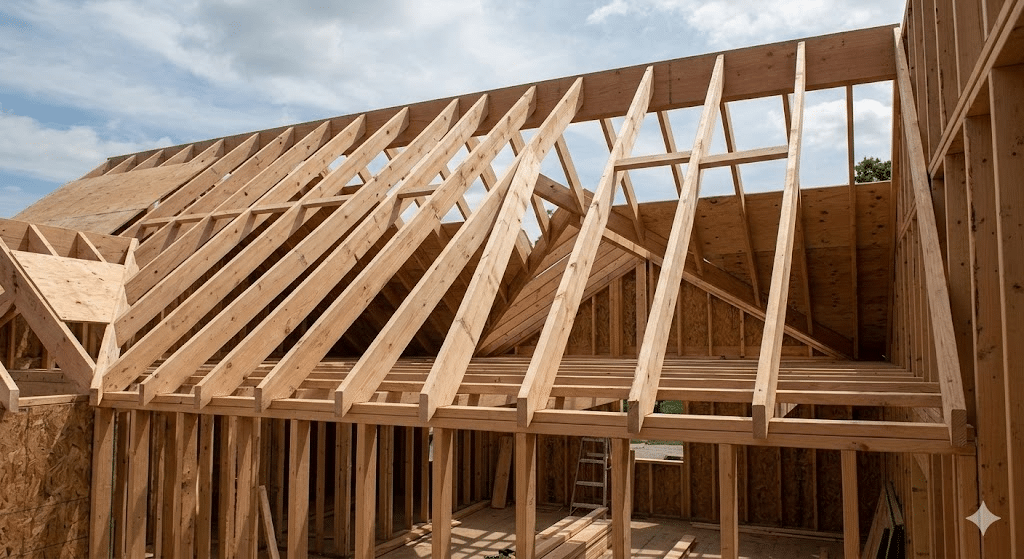
Rafters, sometimes called stick framing, are individual structural beams that run from the ridge board at the peak of the roof down to the top plate of the exterior wall. Each rafter is cut and installed one at a time on the job site by a skilled framing crew. A traditional rafter system includes the rafter beams themselves, a ridge board or ridge beam at the peak, ceiling joists that span the width of the building to resist the outward thrust of the rafters, and collar ties or rafter ties that provide additional structural support.
Rafter framing has been used in residential construction for centuries and remains popular for custom homes, renovations, and projects where attic space utilization is a priority. Because each rafter is individually cut and placed, this method offers considerable design flexibility.
What Are Trusses?

Trusses are pre-engineered, prefabricated structural frames manufactured in a factory and delivered to the job site as complete units. A standard residential truss is a triangular frame made up of the top chord, which follows the slope of the roof, the bottom chord, which spans the width of the building and forms the ceiling, and web members, which are the interior diagonal and vertical pieces that connect the top and bottom chords and distribute loads throughout the structure.
Trusses are designed using specialized software that calculates the exact dimensions, angles, and connection points needed to support the specific loads of your roof. They are assembled in a controlled factory environment using metal connector plates and are engineered to meet or exceed local building codes. In the DFW area, trusses are the dominant framing method for new residential construction.
Cost Comparison: Rafters vs. Trusses in the DFW Market
Cost is often the deciding factor in the rafters vs. trusses decision. Here is a detailed breakdown of what each option typically costs in the North Texas market.
Truss Costs
Trusses are generally the more affordable option for standard residential construction. In the DFW area, you can expect to pay between $3 and $5 per square foot of roof area for standard prefabricated trusses, including delivery. For a typical 2,000 square foot single-story home with a standard gable roof, truss costs typically range from $6,000 to $10,000 for materials.
Installation costs for trusses are lower than for rafters because the framing crew is essentially setting pre-built units in place rather than cutting and assembling individual components. A crew of three to four workers can typically set all the trusses for a standard home in one to two days. Installation labor for trusses generally runs $3,000 to $6,000, bringing the total framing cost to roughly $9,000 to $16,000 for materials and labor combined.
Rafter Costs
Rafters are more expensive both in materials and labor. The lumber for rafter framing is typically higher grade and larger dimension than what is used in trusses. In the DFW market, rafter lumber and hardware generally costs $5 to $8 per square foot of roof area. For the same 2,000 square foot home, material costs typically range from $10,000 to $16,000.
The labor component is where the cost difference becomes most significant. Rafter framing requires a highly skilled crew to measure, cut, and install each individual rafter. This process takes considerably longer, often four to seven days for a standard home, compared to one to two days for trusses. Labor costs for rafter framing typically run $6,000 to $12,000 or more, bringing the total to approximately $16,000 to $28,000 for materials and labor.
The Bottom Line on Cost
For a typical North Texas home, trusses cost roughly 30 to 50 percent less than rafters. That savings can be $7,000 to $12,000 or more, depending on the size and complexity of the roof. This cost advantage is the primary reason trusses have become the standard in production home building throughout the DFW metroplex.
Advantages of Trusses for North Texas Homes
Beyond cost savings, trusses offer several specific advantages that make them well-suited for the DFW construction market.
Speed of Installation
In a market where construction timelines are tight and labor availability can be unpredictable, the speed of truss installation is a major advantage. Getting the roof framed and sheathed quickly reduces the time your project is exposed to weather, which is especially important during North Texas storm season from March through June.
Engineered Strength
Every truss is designed by a structural engineer to handle the specific loads it will face, including dead loads from roofing materials, live loads from maintenance workers, wind loads per local building codes, and in some cases, snow loads for occasional North Texas winter events. This engineering provides a level of structural confidence that is difficult to match with field-framed rafters.
Longer Spans Without Interior Support
Modern trusses can span distances of 40 feet or more without requiring interior load-bearing walls. This allows for open floor plans that are extremely popular in DFW home design. With rafters, achieving comparable spans often requires larger, more expensive lumber or the addition of interior support walls or beams.
Consistency and Quality Control
Because trusses are manufactured in a controlled factory environment, they are built to precise specifications with minimal variation. Every connection point is secured with engineered metal connector plates that provide consistent strength. This quality control reduces the risk of framing errors that can lead to roof problems down the road.
Advantages of Rafters for North Texas Homes
While trusses win on cost and speed, rafters offer distinct advantages in several situations.
Usable Attic Space
The biggest advantage of rafters is the open attic space they create. Without the web members that crisscross the interior of trusses, a rafter-framed attic can be finished into living space, a home office, a playroom, or additional storage. In the DFW real estate market, where home values have been steadily climbing, the ability to add usable square footage in the attic can provide significant return on investment.
Design Flexibility
Rafters allow for complex roof designs, including cathedral ceilings, vaulted spaces, exposed beam aesthetics, and unique architectural features. If you are building a custom home in Southlake, Keller, or another DFW community where distinctive design is a priority, rafters give you and your architect more freedom to create the exact look and feel you envision.
Renovation Compatibility
For additions, remodels, and historic restorations, rafters are often the practical choice. Trusses must be delivered as complete units, which requires crane access and adequate space for maneuvering. Rafter materials can be carried through existing structures and installed in tight spaces where trusses simply cannot reach.
On-Site Adjustments
Because rafters are cut and installed individually, adjustments can be made on-site to accommodate unexpected conditions. If a wall is slightly out of square or an existing structure does not perfectly match the blueprints, a skilled framing crew can adapt rafter cuts in real time. With trusses, any deviation from the engineered design requires the manufacturer to produce new or modified units.
Which Option Is Best for Common DFW Home Scenarios?

The right choice depends on your specific project. Here are recommendations for common scenarios in the North Texas market.
New Production Home Construction
For standard new construction in DFW, trusses are almost always the most cost-effective and practical choice. The savings in both materials and labor make a meaningful difference in the overall construction budget, and the engineered strength provides excellent long-term performance.
Custom Home Builds
If you are building a custom home where design flexibility, cathedral ceilings, or usable attic space are priorities, rafters may be worth the additional investment. The cost premium pays for itself through enhanced design options and potentially increased home value.
Home Additions and Renovations
For additions to existing homes, the choice depends on the scope and access. If the addition is a standalone section with good crane access, trusses remain the cost-effective option. For smaller additions, second-story additions that tie into existing roof lines, or projects with limited access, rafters provide the necessary flexibility.
Garage and Accessory Structure Construction
Detached garages, workshops, and accessory buildings across the DFW area are almost universally framed with trusses. The cost savings are significant for these simpler structures, and the speed of construction means your outbuilding can be enclosed quickly.
Climate Considerations for North Texas Roof Framing
The DFW climate presents specific challenges that should factor into your rafters vs. trusses decision.
Wind Resistance
North Texas experiences frequent high winds, particularly during severe thunderstorms. Both rafters and trusses can be engineered to handle high wind loads, but trusses have an advantage in consistency. Each truss is engineered to the same specification, ensuring uniform wind resistance across the entire roof structure. With rafters, the quality of wind resistance depends on the consistency of the framing crew’s work, including proper nailing patterns and connection hardware.
Heat and Ventilation
DFW summers put enormous stress on roofing systems. Proper attic ventilation is critical for both truss and rafter systems, but the approach differs. Truss-framed attics with their web members can accommodate batt or blown insulation across the bottom chord, with ventilation flowing through soffit vents, up through the attic space, and out through ridge vents. Rafter systems require insulation to be placed between or below the rafters, which demands careful attention to maintaining ventilation channels between the insulation and the roof sheathing.
Expansion and Contraction
The extreme temperature swings common in North Texas cause all building materials to expand and contract. Trusses, because they are single pre-assembled units, handle this movement as a unified structure. Individual rafters may move slightly differently from one another, though proper installation techniques minimize this concern.
Talk to a DFW Roofing Contractor Before You Build
Whether you are planning new construction, adding onto your existing home, or evaluating your current roof structure, getting the right guidance from an experienced North Texas roofing contractor makes all the difference. Understanding your options for rafters and trusses upfront saves both time and money on your project.
Veteran Brothers Roofing and Restoration works with homeowners and builders throughout the Dallas-Fort Worth metroplex on new construction roofing, roof replacements, and structural assessments. We offer complimentary consultations to help you make the most informed decision for your project and budget.
Call us today at (817) 875-9834 to schedule your complimentary roofing consultation. Our team proudly serves Fort Worth, Arlington, Keller, Southlake, and communities across North Texas.
Frequently Asked Questions
Are trusses always cheaper than rafters in the DFW area?
In most standard residential applications, yes. Trusses typically cost 30 to 50 percent less than rafters when you factor in both materials and labor. However, for very small projects, complex roof designs, or renovations with limited access, rafters can sometimes be comparable in cost or even more practical. Getting quotes for both options from experienced contractors is the best way to compare costs for your specific project.
Can I convert a truss attic to living space later?
Converting a truss attic to living space is significantly more complicated and expensive than finishing a rafter-framed attic. The web members in trusses cannot simply be removed because they are structural components. Conversion requires engineering a new support system, which can cost as much as or more than the original framing. If you think you may want to use your attic as living space in the future, rafter framing or attic trusses, which are specially designed with open center space, are the better investment up front.
How do I know if my existing North Texas home has rafters or trusses?
The easiest way to check is to look in the attic. If you see a network of diagonal and vertical wood members connecting the top of the roof to the ceiling, you have trusses. If you see large, individual beams running from the peak down to the walls with an open space in between, you have rafters. Most DFW homes built before the 1970s are more likely to have rafters, while homes built from the 1980s onward predominantly use trusses.
Do rafters or trusses hold up better in North Texas storms?
Both systems perform well when properly engineered and installed. Trusses have the advantage of factory-controlled quality and engineered connections at every joint. Rafters rely more heavily on the skill of the framing crew and the quality of on-site connections. The key factor in storm performance is not so much the framing type but the quality of the hurricane clips and strapping that connect the roof framing to the walls below. Make sure your roofing contractor uses approved connection hardware regardless of which framing system you choose.
About Veteran Brothers Roofing & Restoration
Veteran Brothers Roofing & Restoration is a trusted roofing company proudly serving homeowners and businesses throughout the Dallas-Fort Worth metroplex. Founded by military veterans, our team brings the same discipline, integrity, and attention to detail that defined our service to our country into every roofing project we take on. From roof structure assessments and storm damage restoration to full roof replacements and new construction roofing, we deliver exceptional craftsmanship backed by honest communication and transparent pricing. We proudly serve communities across the DFW area, including Fort Worth, Dallas, Arlington, Keller, Southlake, Grapevine, Bedford, Euless, and North Richland Hills. Contact us at (817) 875-9834 to schedule your free roof inspection today.
INCOMING MESSAGE
It’s storm season. If you think there’s been storm damage to your roof, or would simply like the peace of mind of knowing you’re in the clear, Veteran Brothers is here to help.
