03/08/2026
The Homeowner’s Guide to Attic Insulation and Its Impact on Your North Texas Roof

Your attic insulation plays a far bigger role in your home’s comfort and longevity than most Dallas-Fort Worth homeowners realize. When insulation is properly installed and maintained, it helps regulate indoor temperatures, reduces energy costs, and directly protects the structural integrity of your roofing system. When it falls short, the consequences can include premature roof deterioration, ice-related damage during rare North Texas cold snaps, and monthly energy bills that keep climbing.
For homeowners across Fort Worth, Dallas, Arlington, Keller, Southlake, and surrounding communities, understanding attic insulation is not just about comfort. It is about safeguarding one of the largest investments you will ever make: your home. North Texas experiences extreme heat in summer, occasional freezing temperatures in winter, and high humidity that can cause moisture problems if your attic is not properly insulated and ventilated.
Whether you are building a new home, replacing your roof, or simply trying to reduce your energy costs, this guide covers everything you need to know about attic insulation and how it connects to the health of your roof.
What Is Attic Insulation and Why Does It Matter?
Attic insulation is the material installed between and above the joists in your attic space to create a thermal barrier between your living areas and the outdoor environment. Its primary purpose is to slow the transfer of heat, keeping warm air inside during winter and preventing excessive heat from entering during summer.
In the Dallas-Fort Worth metroplex, where summer temperatures regularly exceed 100 degrees Fahrenheit, an under-insulated attic can turn into a superheated space that radiates warmth down into your living areas. This forces your HVAC system to work overtime, driving up energy costs and putting additional stress on your roofing materials from the underside.
The Connection Between Insulation and Roof Health
Many homeowners do not realize that poor attic insulation can directly damage their roof. When heat builds up in an uninsulated or poorly insulated attic, it bakes the underside of your roof decking and shingles. Over time, this accelerates the aging of asphalt shingles, causes them to curl or crack prematurely, and can void manufacturer warranties.
During colder months, inadequate insulation allows warm air from your home to rise into the attic and heat the roof deck unevenly. In rare North Texas ice events, this uneven heating causes snow and ice to melt and refreeze at the eaves, creating ice dams that can force water beneath your shingles and into your home.
Types of Attic Insulation for North Texas Homes
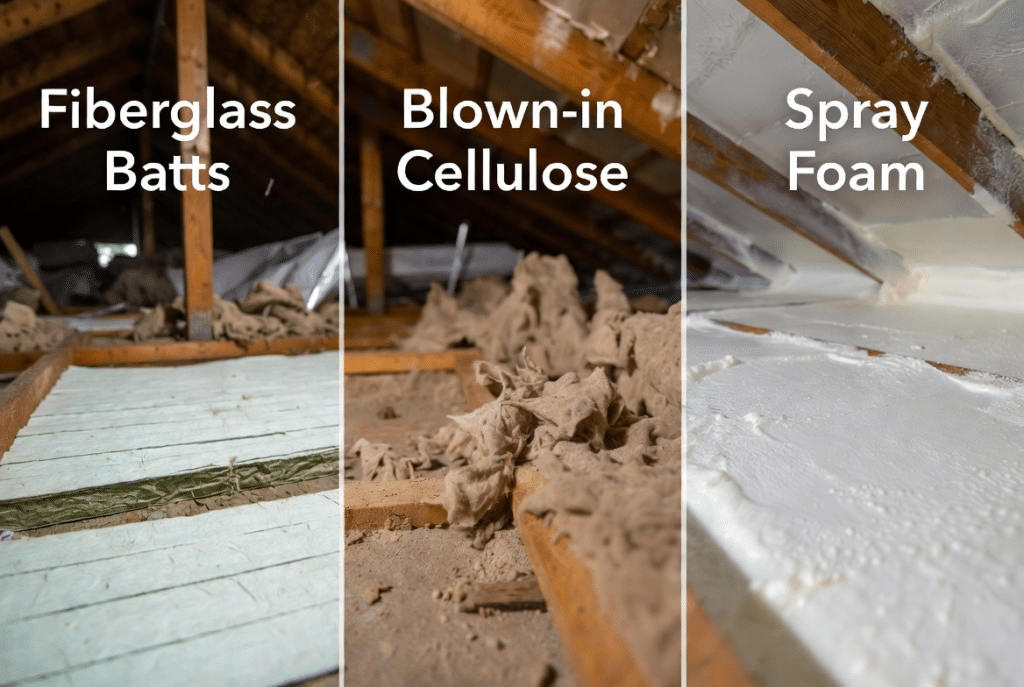
Choosing the right attic insulation depends on your home’s design, your budget, and your performance goals. Here are the three most common options available to DFW homeowners.
Fiberglass Batt Insulation
Fiberglass batts are pre-cut panels of spun glass fibers that fit between standard attic joists. They are one of the most affordable insulation options and are widely available at home improvement stores throughout the DFW area. Fiberglass batts typically provide R-values between R-13 and R-38 per layer, depending on thickness.
The main advantage of fiberglass batts is their low upfront cost. However, they must be installed carefully to avoid gaps, compression, and areas where insulation does not make full contact with the surfaces it is meant to protect. Poor installation significantly reduces their effectiveness.
Blown-In Cellulose Insulation
Blown-in cellulose is made from recycled paper products treated with fire retardants. A professional installer uses a machine to blow the loose-fill material into your attic space, where it settles into gaps, crevices, and hard-to-reach areas that batts often miss.
Cellulose insulation is an excellent choice for retrofitting older North Texas homes that may have irregular joist spacing or existing insulation that needs to be supplemented. It provides an R-value of approximately R-3.2 to R-3.8 per inch and creates a denser barrier that helps reduce air infiltration.
Spray Foam Insulation
Spray foam insulation comes in two varieties: open-cell and closed-cell. Open-cell spray foam provides an R-value of roughly R-3.7 per inch, while closed-cell spray foam delivers R-6 to R-7 per inch. Both types expand on contact to fill gaps, seal air leaks, and create a continuous thermal barrier.
Closed-cell spray foam is the premium option for DFW homeowners seeking maximum energy efficiency. It also adds structural rigidity to roof decking and provides a moisture barrier. The trade-off is cost. Spray foam installations typically run two to three times more than blown-in cellulose for the same area.
R-Value Requirements for North Texas Homes
The R-value of insulation measures its resistance to heat flow. The higher the R-value, the more effective the insulation is at slowing heat transfer. For attic insulation in the Dallas-Fort Worth area, the U.S. Department of Energy and the International Energy Conservation Code (IECC) recommend R-38 to R-60, depending on the specific climate zone and local building codes.
North Texas falls within Climate Zone 3, which means homes in Fort Worth, Dallas, Arlington, Grapevine, Bedford, Euless, and North Richland Hills should aim for at least R-38 in their attic spaces. Homes seeking higher energy efficiency or those with electric heating systems should target R-49 to R-60.
How to Determine Your Current R-Value
If your attic has fiberglass batt insulation, you can estimate its R-value by measuring the thickness. Each inch of fiberglass provides roughly R-2.9 to R-3.8 in value. For blown-in cellulose, each inch provides approximately R-3.2 to R-3.8. If your attic insulation measures less than 10 to 14 inches deep, there is a good chance you are below the recommended R-38 minimum for North Texas.
A professional energy audit, which many DFW utility providers offer at discounted rates, can give you an exact measurement of your current insulation performance and identify areas where upgrades would have the greatest impact.
Signs Your Attic Insulation Needs Attention
Not sure whether your attic insulation is doing its job? Here are the most common warning signs that DFW homeowners should watch for.
Uneven Temperatures Throughout Your Home
If certain rooms feel noticeably warmer or cooler than others, your attic insulation may have gaps, compression, or areas where it has deteriorated. This is especially common in older homes throughout the Fort Worth and Dallas areas that may have original insulation from decades ago.
Rising Energy Bills
When your heating and cooling costs climb steadily despite no changes in usage, inadequate attic insulation is one of the most likely culprits. The U.S. Department of Energy estimates that proper attic insulation can reduce heating and cooling costs by 10 to 50 percent, depending on the home’s current insulation levels.
Visible Damage or Deterioration
Take a look in your attic. If you can see the tops of your ceiling joists, your insulation is too thin. If insulation appears matted, wet, moldy, or has been disturbed by pests, it has lost much of its effectiveness and should be replaced.
Ice Dams or Moisture Issues
While less common in North Texas than in northern states, ice dams can form during winter storms when heat escapes through a poorly insulated attic. If you have noticed water stains on your ceilings, moisture in your attic, or icicles forming along your roofline, your insulation and ventilation system likely need professional evaluation.
Attic Insulation Cost Estimates for DFW Homeowners
The cost of attic insulation varies based on the material, the size of your attic, and whether existing insulation needs to be removed first. Here are typical cost ranges for homes in the Dallas-Fort Worth area.
Fiberglass batt insulation generally costs between $0.50 and $1.50 per square foot installed. For a typical 1,500-square-foot attic, expect to pay $750 to $2,250.
Blown-in cellulose insulation runs approximately $1.00 to $2.50 per square foot installed. A 1,500-square-foot attic typically costs $1,500 to $3,750.
Spray foam insulation is the most expensive option, ranging from $1.50 to $5.00 per square foot for open-cell and $2.50 to $8.00 per square foot for closed-cell. A full attic installation can range from $2,250 to $12,000 depending on the type and coverage area.
Many DFW utility companies, including Oncor, offer rebates and incentives for insulation upgrades that meet specific energy efficiency criteria. These programs can offset a significant portion of your investment.
The Critical Connection Between Insulation and Roof Ventilation

Attic insulation and roof ventilation work as a team. You cannot optimize one without addressing the other. Proper ventilation allows fresh air to enter through soffit vents at the eaves and exit through ridge vents or turbine vents at the peak. This airflow removes excess heat and moisture from the attic space.
When insulation is added without considering ventilation, it can block soffit vents and trap moisture inside the attic. This creates conditions for mold growth, wood rot in your roof decking, and accelerated deterioration of your shingles.
Best Practices for DFW Homes
Professional roofing contractors who understand the unique demands of the North Texas climate will ensure that insulation upgrades include proper ventilation baffles installed at the eaves. These baffles maintain a clear air channel between the insulation and the roof decking, allowing your ventilation system to function as designed.
Protect Your North Texas Roof with Proper Insulation and Ventilation
If you are replacing your roof, it is the ideal time to evaluate and upgrade your attic insulation and ventilation together. This approach ensures that all components of your roofing system work in harmony to protect your home.Ready to Protect Your North Texas Roof With Better Attic Insulation?
If your home is showing signs of inadequate attic insulation — rising energy bills, uneven temperatures, or premature roof wear — the team at Veteran Brothers Roofing and Restoration is here to help. Our experienced roofing professionals serve homeowners throughout Fort Worth, Dallas, Arlington, Keller, Southlake, and surrounding DFW communities, and we understand exactly how the North Texas climate demands the best from your insulation and roofing system.
Contact us today at (817) 875-9834 to schedule a complimentary roof and attic inspection. We will evaluate your current insulation levels, ventilation performance, and overall roof health so you can make informed decisions that protect your home for years to come.
Frequently Asked Questions
How often should attic insulation be replaced in North Texas?
Most attic insulation does not have a set expiration date, but its effectiveness can decline over 15 to 20 years due to settling, moisture exposure, and pest damage. Fiberglass batts tend to last 20 to 30 years if undisturbed, while blown-in cellulose may settle over time and require topping off. If your home was built before 2000 and the insulation has never been upgraded, a professional inspection is a smart investment.
Can I add new insulation on top of existing insulation?
Yes, in most cases you can add new insulation over existing material as long as the current insulation is dry, free of mold, and not contaminated by pests. Blown-in cellulose is particularly well suited for layering over older fiberglass batts. However, if your existing insulation shows signs of moisture damage or mold, it should be removed before new insulation is installed.
Does attic insulation affect my roof warranty?
It can. Many shingle manufacturers require adequate attic ventilation as a condition of their warranty. Since insulation directly affects ventilation performance, improperly installed insulation that blocks airflow can void your warranty. Always work with a professional roofing contractor who understands the relationship between insulation, ventilation, and manufacturer warranty requirements.
How do I know if my attic insulation is causing roof problems?
The most common signs include premature shingle aging, curling or buckling shingles, moisture stains on your ceiling, and mold growth in the attic. If your roof is showing signs of wear well before it should, based on its age and material, an attic inspection can help determine whether insulation and ventilation issues are contributing to the problem.
About Veteran Brothers Roofing & Restoration
Veteran Brothers Roofing & Restoration is a trusted roofing company proudly serving homeowners and businesses throughout the Dallas-Fort Worth metroplex. Founded by military veterans, our team brings the same discipline, integrity, and attention to detail that defined our service to our country into every roofing project we take on. From attic insulation evaluations and ventilation upgrades to full roof replacements and storm damage restoration, we deliver exceptional craftsmanship backed by honest communication and transparent pricing. We proudly serve communities across the DFW area, including Fort Worth, Dallas, Arlington, Keller, Southlake, Grapevine, Bedford, Euless, and North Richland Hills. Contact us at (817) 875-9834 to schedule your free roof inspection today.
INCOMING MESSAGE
It’s storm season. If you think there’s been storm damage to your roof, or would simply like the peace of mind of knowing you’re in the clear, Veteran Brothers is here to help.
